

Laser microphone - An exploration of hearing into the unknown.
A Laser Microphone functions like a microscope for sound, amplifying the physical vibrations of tiny objects that are otherwise too quiet to hear.
In everyday scenarios, when an A440 tuning fork is struck, it produces the musical note A. This sound is easily detectable by the human ear because the physical size of the tuning fork allows the sound to project at a noticeable amplitude. However, a smaller piece of metal vibrating at the same 440 Hz frequency won't be audible to the naked ear due to its weaker amplitude. In this situation, a Laser Microphone can "see" the minute vibrations of the metal at 440 Hz and project the note A to the user through headphones or speakers.
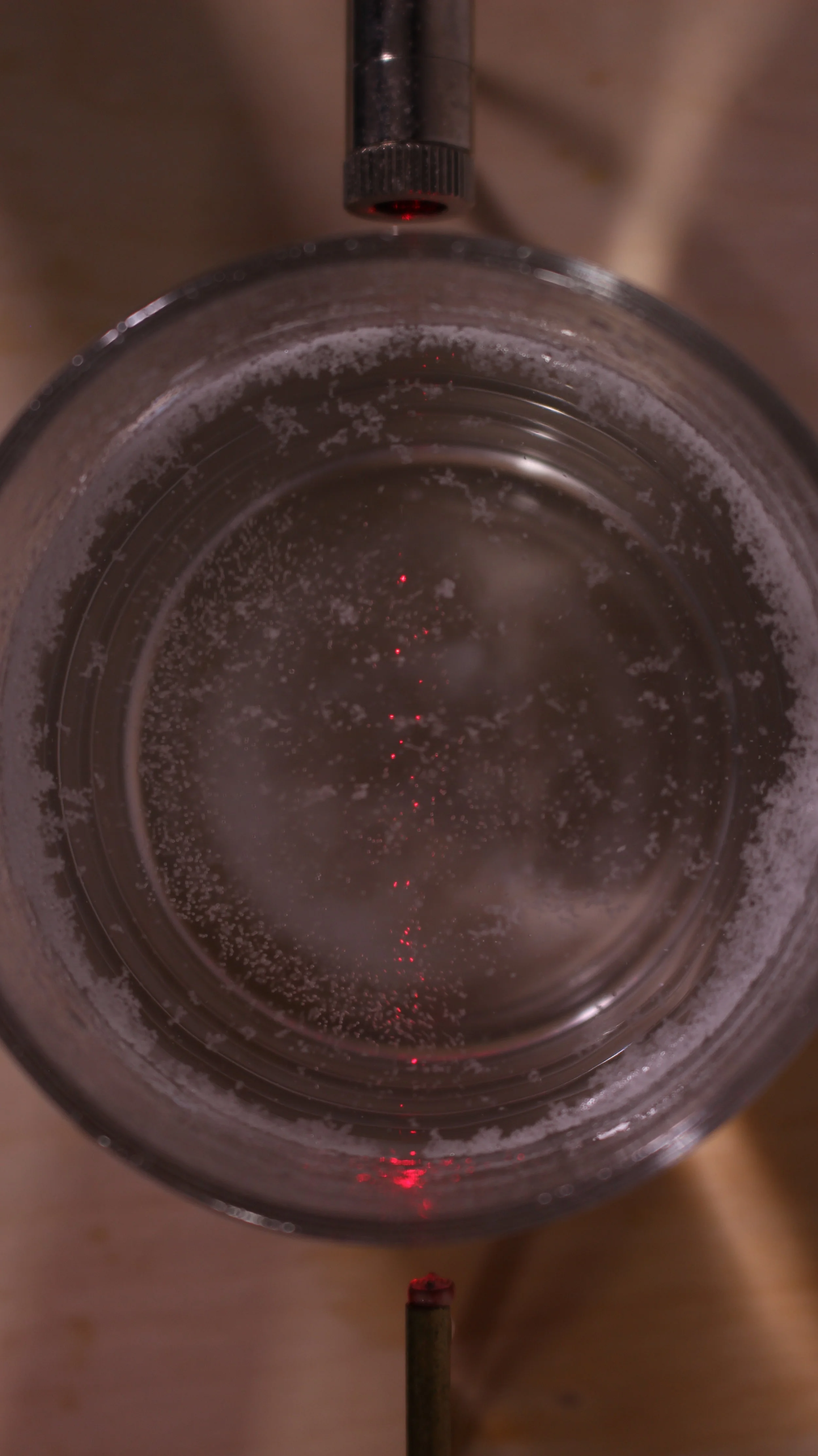
This technology extends far beyond tuning forks and has been used to capture phenomena such as the movement of insect wings, water spray, and the motion of bubbles.


Method
A laser is used to illuminate a vibrating object. When the material of the object oscillates, it disrupts the beam of the laser and casts a shadow on a light sensor placed opposite the laser. The varying light intensity picked up by the sensor is translated into an electrical signal, which is then amplified by a bespoke electrical circuit. This signal can then be fed into an audio playback device such as a set of speakers or a pair of headphones. The technology used is entirely analog, which means that the sound detected by the device is real-time and raw (unprocessed). As it is set up above, acoustic vibrations in line with light are being detected. However, it is also possible to record from reflected beams also, as shown in the renders below.
